Added 5-7-01
Updated 2-4-18
The iron sights fitted to any new rifle should be usable in the same way as those of the current M16A2. However, future rifles issued to infantry squads are likely to have optical scopes too.
An idea worth investigating is that of the long eye relief scope, mounted ahead of the receiver. These have been used in combat on the Kar 98 and is said to contribute to the snap shooting capabilities of Jeff Cooper's scout rifle concept.
Any assault rifle scope should be capable of being quickly changed between two modes – x1 magnification for close combat and x3-4 for longer range shooting.
A case may be made for an additional higher magnification option. This will most probably be useful for “eyeball reconnaissance” and machine gunners.
One of the graticule options for the H&K G36 has a lot to recommend it. The basic design is a set of crosshairs with a circle around their intersection.
It should be possible to create a similar graticule that uses the same sighting protocols as the iron sights of a M16A2. “Single lead rule” used in FM 3.22.9 page 7-38 is given as equivalent to 0.8" at 15 m, 8" at 150 m, 16" at 300 m, so is just under 5 MOA.
This sight might resemble:
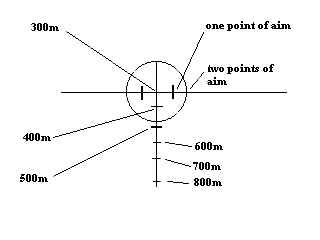 | One point of aim is used for:
Two points of aim are used for:
|
Half the width of the circle, or the distance between the two “one point of aim” marks is equivalent to 18" at 300 m. A frontal figure wider than these marks is within 300 m range.
The diameter of the circle is equal to 2 ft at 200 m, 3 ft at 300 m and 6 ft at 600 m, giving a quick and easily remembered method of range estimation. If a standing man appears to fill ¾ of the circle, range is around 800 m and the graticule gives an aiming mark with the correct holdover.
Diameter of circle is 12 MOA, with “one point of aim” marks being 3 MOA to either side of the crosshairs.
Aiming mark for 400 m is 3.3 MOA below centre, for 500 m 7.5 MOA (just below the bottom of the circle), 600 m 13 MOA, 700 m 20 MOA and 800 m 29.5 MOA.
UPDATE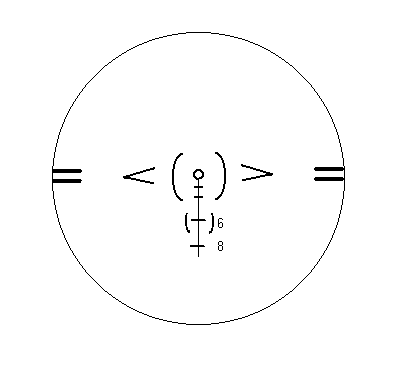 I have been playing the video game “HALO”, and one way to tell what weapon you are using is by the the reticle displayed on your HUD. Some of the alien weapons have novel arrangements such as an X of isosceles triangles, an inverted Y or a dot and two brackets. This got me wondering about minimizing the reticle for better field of view, so here is what I came up with (right). The “ ° ” is the Battle Zero (BZO) of 300 m, and the two “=” help the eye locate this. The vertical line is the bullet trajectory plane, and is marked with impact points at 400, 500, 600 and 800 m The distance between the two brackets corresponds to a man's shoulder width at 300 m - if he fits the brackets or bigger - shoot point blank. There is a set of brackets half the width at the 600 m mark. The < and > are lead markers, and give the correct lead angle for a walking man -about 7-8" at 100 m. 14-16" at 200 m if using a 5.56mm. These marks can be changed if a round with significantly different time of flight is used, or if the user desires a lead marker for a faster moving target. How to use: Put the vertical line on your target (or parallel) and compare him to the two sets of brackets. Then put the appropriate mark on the vertical on your target, allow for wind, and shoot. |
Shotgun ReticleOne of the simplest but most effective reticles on the HALO game is that for the shotgun: just a circle. If it is in the circle, it's dead. 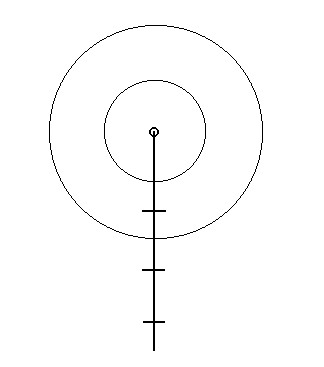 You could calibrate this to represent an inch per yd/m of range. As a rule of thumb the pattern from a true cylinder gun spreads about an inch per yard of range. A full choke gun spreads about half this rate. We could have a reticle that has two circles: the outer that would cover an area such as 30" at 30 yards or 12" at 15 yards. 75 MOA is probably a good size to use. The inner circle would be half the width, so a sort of doughnut. What about slugs? You could put a dot in the centre, but given the trajectory of a shotgun slug that is not that honest. Probably better to drop a vertical line from the centre, marked of in 20-25 m increments. How accurate this is will depend on how you zero your slugs, but it may prove useful in judging the fall of your shot pattern too, so at “long range” you put your circle above the target |
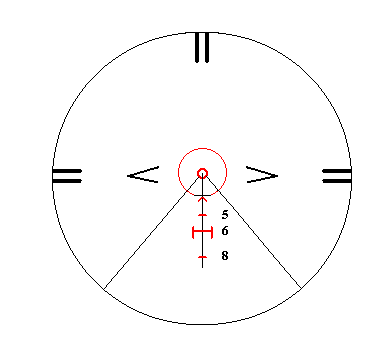
UPDATEMy friend Ed suggested that something like the shotgun sight would also be better for the rifle/LMG sight, since the eye naturally tends to seek the centre of circles. Below is a new suggestion for a graticule based on this idea. Width of the outer circle corresponds to shoulder width at 300 m, or 6 MOA diameter. The distance from the “ ° ” to the top or bottom of the outer circle is equivalent to the apparent height of a man’s head at 300 m. A target whose shoulders fit between the “ ° ” and one side of the circle would be at 600 m, etc. The aiming point for a target at 400 m is designated by an inverted V, while those for 500 m, 600 m and 800 m have a 5, 6 or 8 beside them. The 600 m aiming mark has brackets the equivalent of 3 MOA apart. This system lets the shooter rapidly assess if the target is within 300 m and can be engaged by point blank fire. It also lets the shooter judge if the target is closer or further than 600 m. By comparing the target's apparent size to both the outer circle and the “6 bracket” he can judge which aiming mark is most suitable. Most of these markings will only be noticeable when the scope is magnifying the image. Viewed x 1 the central design will just look like a red topped lollipop, covering 2" of the target at 30 m and 6" at 100 m. Further UPDATEInspired by the sights in the “Rainbow Six” game, I have added what I call “pyramid lines” to the above design. When shooting with magnification, targeting is a case of putting your target within the circle and placing the point of the arrow/ pyramid where you want the bullet to go. When shooting without magnification at shorter ranges just place the circle/lollipop at the apex of the pyramid on the target. |
I originally wrote this article in July 2001.
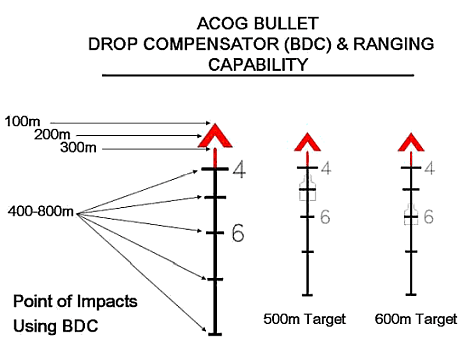
Since this article was first webbed, the Trijicon Advanced Combat Optical Gunsight (ACOG) Scope has come into common usage with US forces.
The ACOG reticle incorporates many of the features I have suggested above. I'm a little unsure of the chevron as an aiming point, so have drawn and alternate version (right) using more of the ideas detailed above.
This design of reticle would be useful for both ACOG and M68 CCO type sights.
 | 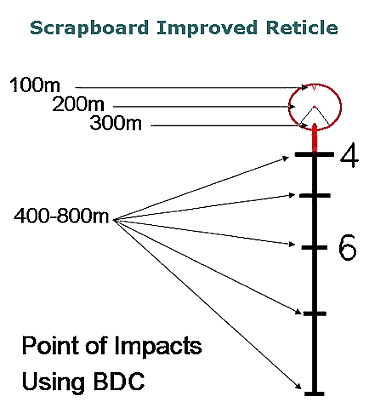 |
Diameter of the circle corresponds to a man's shoulder width (c.19") at 300 m, or 6 MOA.
| 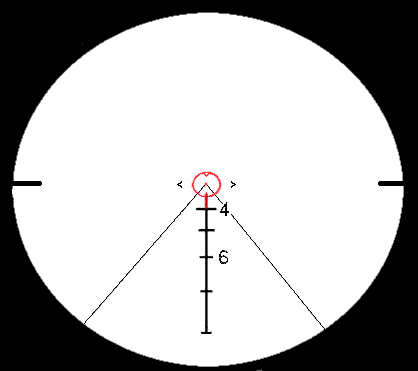 |
A colour version of the reticle suggestion in my book. “Survival Weapons: Optimizing Your Arsenal”. Green circle is shoulder width at 200 m, red square shoulder width at 300 m. Width of “rungs” are shoulder widths at 400, 500, 600, 700 and 800 m, as per ACOG. Apex of green triangle is aim-point for 200 m. Red “spike” on lower edge of square is aim-point for 300 m. The “V” on the top edge of the square is for precise shots at 100 m. The “<” and “>”, vertical sides of the square and bottom corners of the square are used for lead and wind deflection at various ranges as described in the book. Above I have shown a two‑colour display. More useful will be a display that can cycle between colours, as described on this page. A green display is more effective in low‑light conditions. Green may lack sufficient contrast in verdant terrain, hence the red option. | 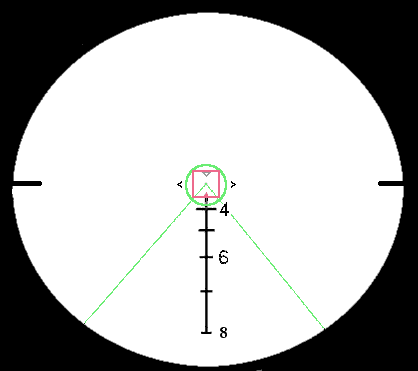 |