The Catchstick
In certain institutions such as youth correctional facilities and mental hospitals there may be a requirement for staff to defend themselves or to control a violent inmate. Impact based weapons such as batons are sometimes used but many have understandable reservations about their widespread use.
On a previous page I have talked about the Gripton Handler-12 and suggested that a modified version of this may see applications in such institutions. On this page I expand on this idea further and suggest an alternate device that we will call the “Catchstick”.
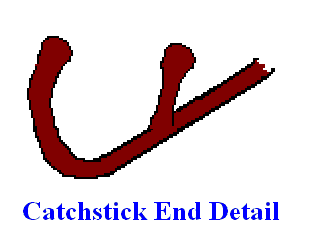 The form of the Catchstick will be that of a straight rod with a hook at each end. This will probably resemble a mathematical “Integer” sign although an alternate form resembling a long straight “C” is an alternative. Several inches below the hook will be a second branch which will be set at an angle of about 60° to the hook when the Catchstick is viewed end on. Each end of the Catchstick will therefore resemble a letter “ f ”. The straight section or shaft will be long enough to accommodate a grasp by both hands held at shoulder width and may be oval in section to facilitate grip. The hooks will have a radius of curvature sufficient to encircle an arm (probably 2¼ -2½”) and terminate in a teardrop shaped section. The mouth of the hook may be slightly narrower than the diameter and hooks that are slightly canted are also possible. Various means of construction are possible but a likely choice will be a spine of aluminum or thin steel tube covered by padding. The Catchstick will be of a light weight to discourage its use as a impact weapon.
The main application of the Catchstick is to facilitate the application of armlocks and similar techniques. To use it effectively one must have some grasp of the basic principles behind such moves.
- Most armlocks involve manipulating the limb so that the joint bends in a direction that it is not designed to move, or bends it further than its natural range of movement.
- Most locks are structurally triangles.
Consider a typical straight arm lock. One hand pushes against the upper arm and the other pulls on the lower arm, straightening the elbow joint further than it wants to go. The triangle is formed by the straight arm and the two arms pulling on it. In other locks two sides of the triangle are formed by the bent foe's arm and force is applied to the side of the elbow.
Many of the locking techniques developed for Canemaster's fighting canes and mini-cane can be used for the Catchstick but the Catchstick is deliberately intended not to be used as a striking weapon and the second hook offers additional options such as the Crank. It's light weight means that it can be carried all day without fatigue so is more likely to be available when needed.
How to use the Catchstick effectively will depend on the user's grasp of these basic concepts and is limited only by opportunity and their imagination. Locks may be applied with either both or one hand holding the Catchstick. The Catchstick also allows techniques that would not be available to an unarmed individual.
- When held between the two hands the shaft of the Catchstick can be used to block or parry both armed and unarmed attacks without injury. This will probably be most effective if both hands are held with the thumbs away from the ends of the stick, as though one were driving a car or grasping a set of barbells.
- The Catchstick can be used for techniques such as “The Crank”. One hook of the Catchstick is hooked around the arm and the Catchstick rotated by grasping the other hook below the teardrop. This clamps the arm between the two sides of the hook.
- The Catchstick can be thrown against the legs of a running individual and its hooked ends make it more likely to trip or entangle the legs than a baton.
- In a crowd control scenario Catchsticks can be grasped between individuals to cordon off an area or corral a group with less manpower. By grasping the hook or shaft section behind a hook as appropriate the hands are offered a measure of protection better than if this was tried with batons. It is also possible that Catchsticks can be hooked together.
The Catchstick is not intended as a generic combat weapon to replace the nightstick but an idea of its application can be gained if we consider its use against someone with a knife or similar weapon. In the applications that it is intended for it is conceivable that a Catchstick user may face an inmate who has armed themselves with a knife, improvised shiv or broken bottle. One is only likely to face such a threat with a Catchstick if there is an immediate threat to one's person. In most situations it is a better option to await colleagues with equipment such as riot shields or to calm the inmate down and talk them into surrendering the weapon.
The following is for purposes of illustration of Catchstick applications. In all case we will assume that the knife is held in the right hand and that the defender starts with the Catchstick grasped with one hand at each end of the shaft.
The defender is to the attacker's right, standing in the attacker's “Outer gate” and with the knife to the right of him. The attacker makes a low thrust which is parried to the right with the shaft of the Catchstick. The lower hook of the Catchstick is hooked under the attacker's forearm and the shaft of the Catchstick laid along the outside of the arm passing inward of the elbow joint. The arm is locked, with the side of the hook pushing on the inside of the forearm to apply lateral pressure to the elbow joint. Alternately the hook is passed around the forearm then twisted so the limb is clamped with the Catchstick shaft nearly perpendicular. By raising the Catchstick up high a painful straight arm lock can be executed.
If the defender is on the inner gate then different techniques are used. The thrust is parried to the left with the shaft and the lower hook hooked under the forearm. The other end of the Catchstick is swung to the outside of the attacker's upper arm and the hands move in a clockwise circle to execute the lock. It may be more comfortable to disengage the right hand from grasping the shaft and instead place it on top of the shaft and knife arm when making this move. A body check with the right shoulder can also be applied when making this move.
Being on the inside gate of a knifeman is more dangerous since you are vulnerable to grappling and attacks by the other hand. It may be more prudent to deflect the attack with your Catchstick then use footwork to move past his left arm and behind him to his outer gate. You then have several options. Some of them are:
- To escape the immediate attack and find help.
- To hook the attacker's neck or collar with the Catchstick and pull him backwards off balance. Hooking and levering attacks applied to the neck can be fatal but in a situation where a knife attack is in progress this risk may be warranted.
- With one hand swing the Catchstick to strike the back of the attacker's knees. Slap the other hand across the attacker's eyes and use any reaction these moves create to pull him backward off balance.
- From behind thrust the Catchstick between attacker's thighs them move to the side and use the leverage to cause him to fall.
- Hook one of the attacker's calves and take the shaft across the shin of his other to pull his feet from under him. Push or shove to encourage this.
Update
 Reading Erle Montaigue's article on Deerhorn knives the following passage struck me:
“Unfortunately in most civilized countries, it is illegal to carry this weapon. And in my country Australia, it is even illegal to purchase the proper knives! I have to make do with a set of wooden weapons. However, if Police officers were to carry a set, any criminal confronted with this weapon would back off very quickly if he were armed with an edged weapon.”
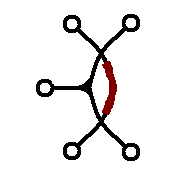
It occured to me that an unsharpened variant of the Deerhorn knife could fulfil a similar role to that envisioned for the Catchstick but be more convienient for staff to carry on their daily rounds. The main innovation is the fifth central horn (right). The patient's limbs can easily be caught between any two of the horns and the other horns grasped for additional leverage. The Deerhorn Restraint device would also make a servicable buckler should the staff member be threatened by an improvized weapon such as a shiv or bottle.